

It’s a 40-degree Adelaide evening, the footy is on, dinner is half-cooked, and then everything goes silent. The fans stop, the fridge stops humming, and your Wi-Fi router blinks out like it’s given up on life. If you’ve lived here a while, you know this isn’t far-fetched. Storms roll in off the gulf, heatwaves push the grid to its limit, and plenty of us still remember the statewide blackout in September 2016.
That’s why more young professionals across the city are asking about generator installation, and I don’t blame them. You might be working from home, running a side hustle, or just protecting a fridge full of groceries that cost far too much this week. In this guide I’ll explain how generator installation actually works, which type suits your place, what it costs, and what to watch for so you stay safe and compliant. No jargon, no fluff, just what makes sense on real jobs around Adelaide.
What Is Generator Installation, and Why Does It Matter in Adelaide?
Generator installation is the process of permanently connecting a backup generator to your electrical system so your home or business keeps running when the grid drops out. It isn’t just dropping a machine in the backyard and hoping for the best. A proper job covers choosing the right unit, picking a safe spot, running the cabling, fitting a changeover switch and testing everything under load. Think of it like a seatbelt: owning one is nice, but it only saves you when it’s connected properly.
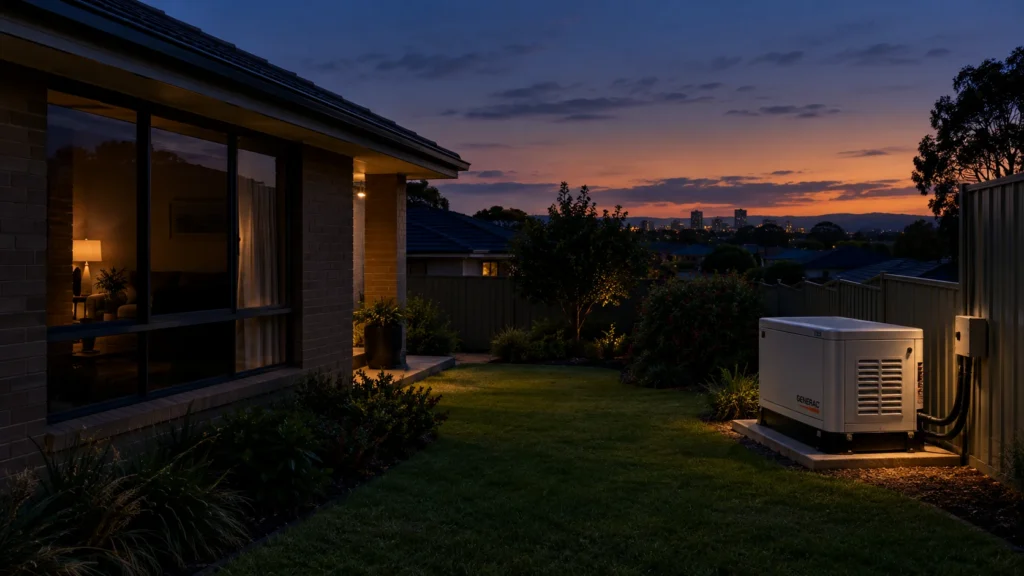
Adelaide is a funny place for power. We get scorching summers that push demand through the roof, sudden storms that snap lines across the suburbs, and bushfire-season risks up in the Hills. Throw in older homes with ageing switchboards and it’s no surprise that emergency backup power has gone from “nice idea” to “sensible upgrade”. A well-planned generator installation keeps your fridge cold, your work laptop charged and your air conditioner humming while everyone else is hunting for candles.
So, is it worth it? Short answer: if an outage costs you food, income or peace of mind, yes. Solar and batteries are brilliant power outage solutions, but a generator with a decent fuel supply can keep going for days, not hours. Plenty of households end up combining the two, and that’s a perfectly good plan.
Backup Generator Adelaide Options: Portable vs Standby
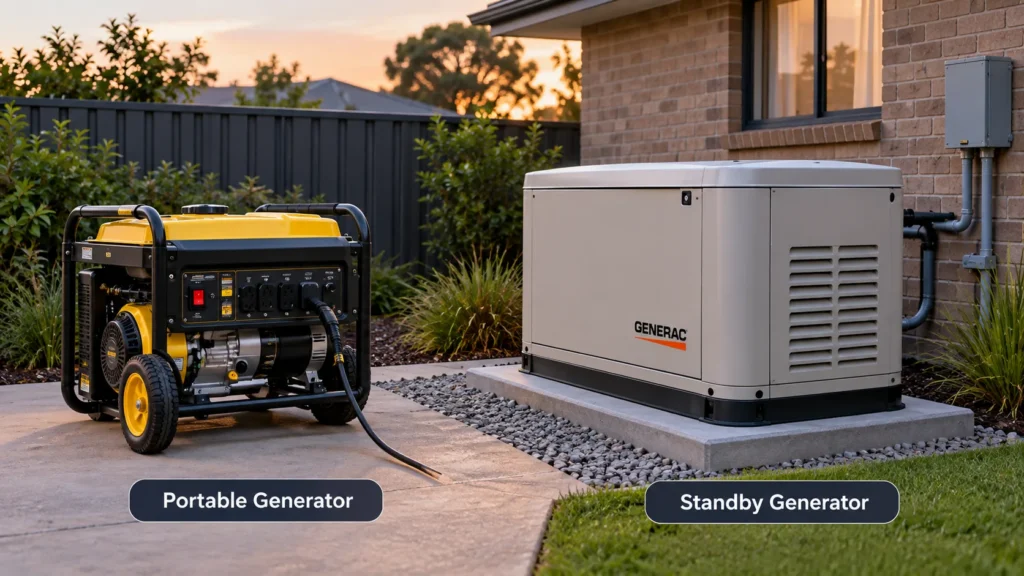
Most people start by comparing two families. A portable unit is the one you wheel out of the shed and fire up with a pull cord or a button. A standby generator in Adelaide, on the other hand, lives permanently beside your house, connects to your fuel supply and can start itself within seconds of an outage. Portable is cheaper upfront, but it needs you to be home, awake and happy to fiddle with fuel in the rain. Standby costs more, yet it works while you’re at the beach at Glenelg or on a flight to Bali. Whichever way you lean, professional generator installation matters more than the badge on the machine.
| Feature | Portable generator | Standby generator |
| Start-up | Manual, you’re needed on site | Automatic within seconds |
| Typical fuel | Petrol or LPG (some dual fuel) | Natural gas, LPG or diesel |
| Coverage | Selected essentials | Essentials or whole home |
| Installation | Power inlet and manual changeover switch | Fixed pad, fuel line and automatic switch |
| Upfront cost | Lower | Higher |
| Best for | Occasional outages and tighter budgets | Frequent outages, home offices, peace of mind |
Which Fuel Type Suits Your Generator Installation?
The best fuel for your generator installation depends on what’s already at your property. Natural gas is the low-fuss option if you’re connected to mains gas, because there’s nothing to refill and no jerry cans to store. LPG suits homes without mains gas, though you’ll need to keep an eye on bottle levels. Diesel is a tough, long-lasting choice and common in commercial settings, while petrol is mostly limited to portable units and goes stale if it sits too long. Gas connections must be handled by a licensed gas fitter, so a good installer coordinates both trades rather than leaving you to play referee.
Generator Sizing Adelaide: How Much Power Do You Actually Need?
Sizing is where most well-meaning buyers trip up. Proper generator sizing in Adelaide comes down to two numbers: your running load, which is what your appliances draw continuously, and your starting load, which is the brief surge when motors kick in. Air conditioner compressors and pool pumps are the classic surge culprits. Undersize the unit and it’ll struggle or trip out. Oversize it and you’ve paid for capacity you’ll never use, plus extra fuel. As a rough guide, a small unit covering essentials often sits somewhere around 5 to 8 kVA, while whole-home coverage can climb well beyond that, so get the numbers checked before any generator installation begins.
When I sit down with a homeowner, we start by deciding what really has to stay on. Backing up every circuit sounds lovely, but it’s a bit like booking a bus for a dinner date. Most people are happy with a shortlist of essentials, and the list below shows what usually makes the cut, roughly from lightest on power to hungriest.
- Fridge, freezer and lighting
- Wi-Fi, laptops and home-office gear
- Ceiling fans and gas heater fans
- Split-system air conditioning (a big surge, so plan for it)
- Electric hot water, ovens and pool pumps (usually the biggest draws)
Once you’ve got your shortlist, your electrician measures actual loads and checks your switchboard. That’s why a proper load assessment should be step one of any generator installation quote, not an afterthought.
Generator Changeover Switch: The Small Part That Keeps Everyone Safe
A generator changeover switch is a device that lets your property draw power from either the grid or the generator, but never both at once. Think of it like railway points: it decides which track the train uses and makes sure two trains never meet head-on. Without one, electricity can flow backwards into the street network, a hazard called backfeeding that can seriously injure line workers and damage your equipment. Skipping it is the single biggest mistake in DIY generator installation.
There are two main types. A manual changeover switch means you flip it yourself when the power drops, which suits portable generators connected through a proper inlet. An automatic transfer switch detects the outage, starts your standby unit and shifts the load across in seconds, then reverses everything when the grid returns. If you’ve ever stumbled around in the dark looking for a torch, you’ll understand why the automatic option is so popular.
Compliance and Generator Safety Adelaide: The Rules You Can’t Skip
Here’s the unglamorous but important bit. Generator installation in South Australia must be carried out by a licensed electrician, and the wiring needs to meet Australian standards such as AS/NZS 3000 (the Wiring Rules) and AS/NZS 3010 (electrical installations for generating sets). For the official word on licensing and electrical safety, have a look at the South Australian Government’s energy and electrical safety information before you sign anything. It’s a short read that could save you a very expensive headache. After the job you should receive paperwork confirming the work complies, such as a Certificate of Compliance, which you’ll want to keep for insurance and resale.
Beyond the paperwork, generator safety in Adelaide comes down to a few common-sense rules. Never run a generator inside a garage, shed or enclosed space, because carbon monoxide is odourless and deadly. Keep the exhaust well away from windows, doors and vents, and follow the manufacturer’s clearances. Clear dry grass and leaf litter from around the unit in fire season and store fuel in approved containers. Safe generator installation is really just careful planning in a hi-vis vest.
Placement, Noise and Neighbours
Where the generator goes matters almost as much as which one you buy. A good spot is outdoors, on a level pad, with airflow around it, clear access for servicing and a sensible distance from openings into the house. Shorter cable runs to your switchboard also keep costs down, which is a nice bonus.
Then there’s noise. A running engine at 2 am isn’t a great look, especially in tighter suburbs like Norwood or Prospect where fences are close. Many standby models are designed to be quieter, and sound-rated enclosures can help. A quick chat with your neighbours before installation day costs nothing and can save you from some awkward over-the-fence conversations.
Home Generator Installation: What Actually Happens on the Day
A typical home generator installation follows a predictable order, and knowing it helps you tell a professional from a cowboy. The steps below are the ones I’d expect any reputable crew to follow, and they explain why a decent job takes longer than “plug it in and go”.
- Site assessment: the electrician checks your switchboard, meter box, fuel supply and possible locations.
- Load calculation: essential circuits are identified and the generator is sized to suit.
- Base and placement: the unit is positioned on a level pad with correct clearances.
- Fuel connection: a licensed gas fitter or fuel supplier connects the supply where needed.
- Wiring and changeover: the generator electrical installation is completed, including the changeover switch and earthing.
- Commissioning: the system is tested under real load so you know it works before you need it.
- Handover: you get a walkthrough, the paperwork and a maintenance plan.
Don’t let anyone skip commissioning. It’s the moment your generator installation proves itself, and it’s far better to find a fault on a sunny Tuesday than in the middle of a storm.
How Much Does Generator Installation Cost in Adelaide?
Let’s talk money, because everyone wants to. The cost of generator installation varies widely because no two properties are alike. A portable generator with a proper inlet and changeover switch sits at the lower end, while a full standby system with automatic switching, gas connections and a purpose-built pad can run into the thousands, sometimes well past ten thousand dollars for larger homes. The main drivers are generator size, fuel type, switchboard condition, cable runs and how many circuits you want covered.
My honest advice? Don’t chase the cheapest generator installation quote. Ask for an itemised breakdown, check what’s included (the switch, the pad, testing, paperwork) and compare like with like. A low price that leaves out the changeover switch isn’t a bargain; it’s a risk with a discount sticker on it. Factor in running costs too, such as fuel, servicing and the occasional replacement battery.
Renting or Living in a Unit? What Young Professionals Should Know
Not everyone owns a house with a side yard, and that’s fine. If you rent, a permanent setup needs your landlord’s approval, and in a unit or townhouse it may also need strata or body corporate sign-off. That can be a hurdle, so ask early rather than after you’ve bought the gear.
If a fixed system isn’t realistic, focus on smaller fixes: a portable power station for your laptop and router, a battery-backed setup for essentials, or a chat with your landlord about a shared solution for the building. A permanent system isn’t for everyone, but knowing your options beats sitting in the dark wondering.
Keeping Your Backup Power Ready After Installation
Once your generator installation is finished, the work isn’t quite over. A generator is like a gym membership: it only pays off if you actually use it. Run it regularly, ideally monthly or as the manufacturer recommends, so the engine stays lubricated and the battery stays charged. Standby units often run their own scheduled exercise cycles, which is handy. Get it serviced annually, check fuel levels before storm and bushfire season, and keep the area around it clear. If it fails to start on the big night, it’s usually because nobody looked at it for eighteen months.
Choosing the Right Generator Installation Electrician in Adelaide
The machine matters, but the person wiring it matters more. Look for a licensed electrician with real experience in generator electrical installation, fully insured, who’s happy to explain the plan in plain English. At Hybrid Electrical, generator installation is part of a bigger safety picture: sizing correctly, wiring cleanly and testing thoroughly. Two of the most common problems we see are undersized units and missing changeover switches, both easily avoided with proper planning.
Good installers also stick around after the job. Ask about warranties, servicing and what happens if something doesn’t work as expected. A quality generator installation should leave you with a working system, a tidy switchboard, the right paperwork and someone to call. Ask questions, request references and trust your gut; if it feels rushed, it probably is.
Conclusion
Reliable backup power comes down to a few smart decisions. Choose between a portable and a standby generator, size it properly for your real loads, fit a compliant changeover switch, and use a licensed electrician who follows Australian standards. Get the generator installation right and you protect your food, your work and your safety, and you avoid the dangers of backfeeding and carbon monoxide. Add regular maintenance and a realistic budget, and you’ve got a system that quietly does its job when the lights go out.
If you’re ready to stop worrying about the next storm or heatwave, we’d love to help. Hybrid Electrical can assess your property, recommend the right unit and handle the whole generator installation from sizing to sign-off. Contact us today for a straightforward chat and a clear quote, and let’s get your backup power sorted before the next outage finds you in the dark.
FAQs
1. How long does generator installation take?
Most generator installation jobs for homes take around one to two days, depending on the fuel connection, the condition of your switchboard and the type of switch being fitted. Larger or more complex sites can take longer. Your electrician can give you a realistic timeframe after the site assessment.
2. Do I need a licensed electrician for generator installation?
Yes. Connecting a generator to your property’s wiring is regulated electrical work in South Australia, so it must be done by a licensed electrician, with gas connections handled by a licensed gas fitter. DIY connections are dangerous for you, your neighbours and line workers, and they can put your insurance and warranties at risk.
3. Can I plug a generator into a power point?
No, and please don’t try. Feeding power into a household outlet can backfeed into the grid and create a serious shock hazard. The safe way is a compliant inlet and a generator changeover switch installed by a licensed electrician, so your home is properly isolated from the network.
4. What size generator do I need for a typical Adelaide home?
It depends on what you want to keep running. A smaller unit around 5 to 8 kVA often covers essentials like the fridge, lights, Wi-Fi and a split-system air conditioner, while whole-home backup needs a larger unit. Because starting loads and switchboard capacity vary, a proper load assessment is the only reliable answer.
5. Is a generator better than solar and a battery for power outages?
Neither is universally better. A battery is quiet and instant, but its runtime is limited by its capacity, while a generator can run for days as long as you have fuel. Many Adelaide households combine them, using the battery for everyday resilience and the generator as long-haul insurance.