

The number of electric vehicles on Adelaide roads has grown significantly over the past two years and the questions I get asked about home EV charger installation have grown with it. Most of the homeowners who call me have already bought the car — or are days away from taking delivery — and are working out the charging setup at the last minute. Some have been told by the dealership that they can just plug into a standard 10-amp power point at home and that will be fine. A few have been given quotes by installers who have given them a number without inspecting the property or assessing the switchboard. And a lot of them are confused about the difference between a 7kW charger, a 22kW charger, and whether their home solar system changes anything about the equation.
This guide gives you the honest, practical picture of what EV charger installation in an Adelaide home actually involves — what options are available, what your electrician needs to assess before quoting, what it costs, and what questions to ask before signing off on any installation.
The Difference Between Home EV Charging Options
Home EV charging in Australia falls into two categories that are sometimes called Level 1 and Level 2, though these terms are more commonly used in North America. In practical Australian terms the distinction is between standard power point charging and dedicated home charging station installation.
Standard power point charging — plugging your EV into a regular 10-amp or 15-amp power point using the cable that comes with the vehicle — is technically functional but delivers very slow charging rates. A 10-amp standard outlet delivers approximately 2.4kW of power, which translates to roughly 10 to 15 kilometres of range per hour of charging depending on the vehicle. For a commuter who drives 40 to 50 kilometres per day and plugs in every night, this is often sufficient. For a family with a longer daily range or a larger battery capacity, it means the car is rarely fully charged and range anxiety becomes a real daily consideration.
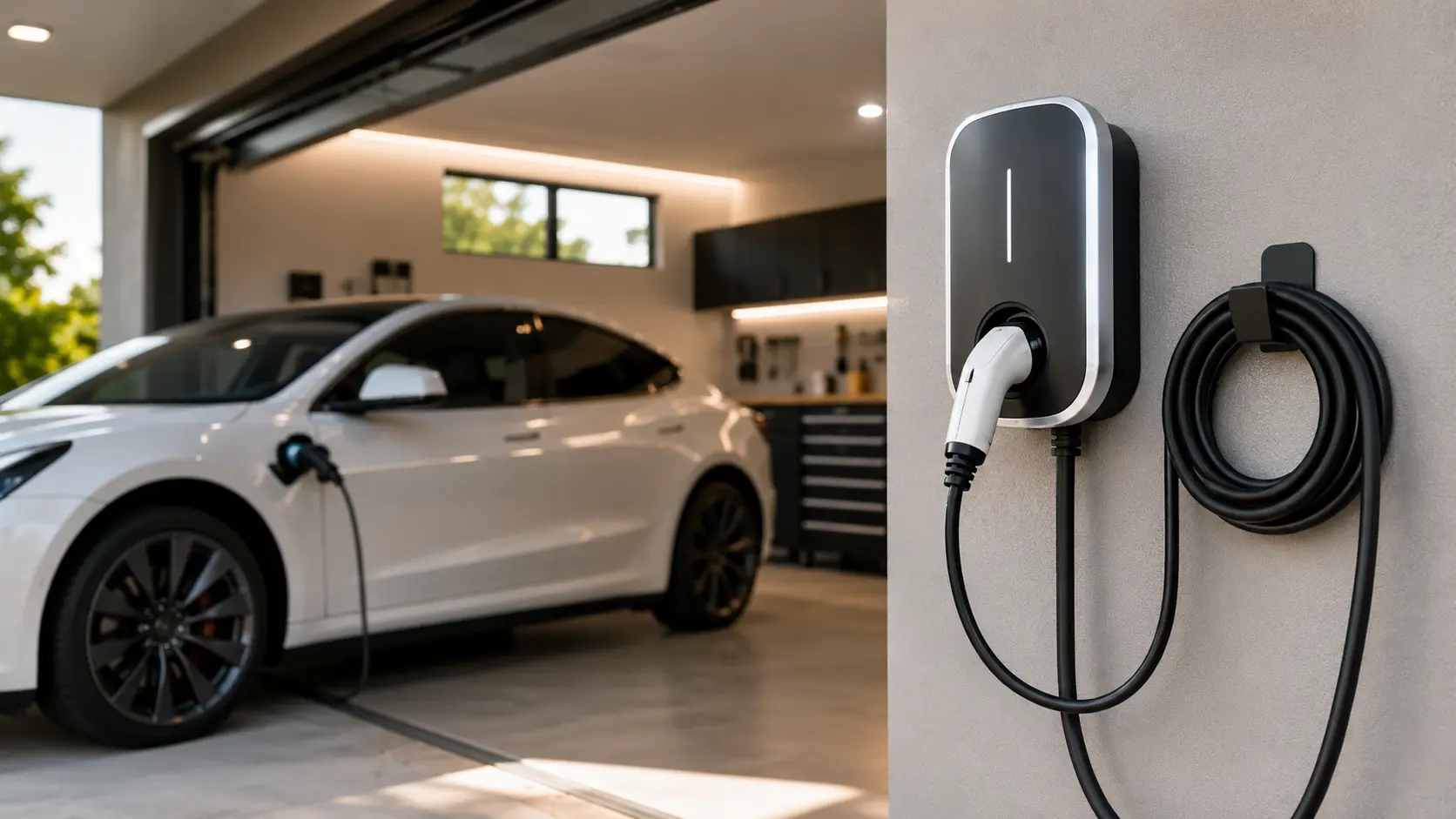
A dedicated home charging station — a wall-mounted unit installed by a licensed electrician on a dedicated circuit — delivers significantly faster charging. A standard single-phase 7.4kW home charging unit charges at approximately 40 to 50 kilometres of range per hour, meaning most EVs can be charged from near-empty to full in four to eight hours overnight. For Adelaide homeowners with solar systems, a smart charger that can be programmed to charge during peak solar production hours rather than overnight grid draw makes genuine economic sense and is worth the additional investment over a basic unit.
What Your Electrician Needs to Assess Before Installation
A credible EV charger installation quote cannot be provided without a proper site assessment. Any installer who quotes you a price from a phone conversation without inspecting your switchboard, assessing your current electrical load, and evaluating your preferred charger location is giving you a figure that may be significantly different from the actual job cost.
The switchboard assessment is the most critical element. Your switchboard needs to have an available circuit breaker slot and the capacity to support an additional dedicated circuit for the charger. Most Adelaide homes built in the last twenty years have consumer mains boards with room for additional circuits. Older homes with smaller boards or boards that are already at capacity may need a switchboard upgrade as part of the EV charger installation — a legitimate additional cost that needs to be identified upfront rather than discovered on installation day.
The cable run from the switchboard to the preferred charger location also affects cost significantly. A garage that is directly adjacent to the switchboard requires a short cable run and minimal installation time. A garage at the far end of a property from the switchboard, or a carport that requires cable to be run underground or through external conduit across a long distance, adds material and labour cost. The installation team needs to walk this route and assess it before quoting.
For Adelaide homes with solar systems, assessing the solar inverter setup is important for homeowners considering a solar-integrated smart charger that diverts excess solar generation to EV charging rather than exporting it to the grid. Not all inverters are compatible with all smart charger brands and this compatibility needs to be confirmed before purchasing a charger unit.
EV Charger Installation Costs in Adelaide in 2026
Home EV charger installation in Adelaide in 2026 ranges from approximately $800 to $2,500 for a straightforward installation, depending on the charger unit selected, the cable run distance, and whether any switchboard work is required.
A basic 7.4kW single-phase charger installation with a short cable run from the switchboard and no switchboard modifications typically falls in the $800 to $1,200 range for labour and installation, plus the cost of the charger unit itself which ranges from $400 to $1,500 depending on brand and features. A smart charger with solar integration and app-based scheduling typically costs more than a basic unit but delivers better value for homeowners with solar systems.
Where costs increase beyond this baseline are in longer cable runs requiring additional conduit and cable, properties where a switchboard upgrade is needed before the charger circuit can be added, and installations requiring underground cable runs to carports or detached garages. These are all legitimate cost variables that a proper site assessment will identify clearly before any work begins.
Solar Integration and EV Charging in Adelaide
Adelaide has one of the highest rates of residential solar installation in Australia, and the combination of home solar and EV charging is a genuinely powerful economic pairing when set up correctly. The basic principle is straightforward — your solar system generates power during daylight hours, and if your EV is connected and a smart charger is installed, the charger can be programmed to use that generation to charge the vehicle rather than exporting it to the grid at the current low feed-in tariff rate.
The economic benefit depends on the size of your solar system, your daily driving distance, and whether you can charge during peak solar hours. For an Adelaide household with a 6.6kW solar system and a daily commute of 40 to 60 kilometres, intelligent solar-integrated EV charging can effectively make the daily commuting cost close to zero — the solar energy that previously exported at a low feed-in rate is now powering the vehicle instead.
The technical requirement for solar-integrated charging is a smart charger that can communicate with your solar system or smart meter to modulate its charging rate based on available excess solar generation. Not all charger brands offer this functionality and not all configurations are compatible with all solar inverter brands. This is an important conversation to have with your installer before purchasing a charger unit.
Comparing Home EV Charging Options
| Option | Charging Speed | Installation Cost | Best Suited For |
| 10-amp standard outlet | 2.4kW — 10–15 km/hr | Nil — outlet already exists | Low daily usage commuters |
| 15-amp dedicated outlet | 3.6kW — 15–20 km/hr | $300–$600 | Light use, small battery vehicles |
| 7.4kW dedicated charger | 7.4kW — 40–50 km/hr | $800–$1,500 installed | Most Adelaide homeowners |
| Smart solar-integrated charger | 7.4kW with solar scheduling | $1,200–$2,500 installed | Solar households wanting maximum value |
Conclusion
EV charger installation in Adelaide is a straightforward project when it’s planned properly — the right charger for your vehicle and usage pattern, the right assessment of your switchboard and cable run requirements, and the right integration with your solar system if you have one. The most important step is getting a proper site assessment from a licensed electrician before purchasing any equipment, so the installation scope and total cost are clear before you commit.
If you’re planning EV charger installation for your Adelaide home and want honest advice about the best setup for your vehicle, your property, and your solar system, contact us at Hybrid Electrical and we’ll organise a site assessment and provide a clear, detailed quote.
FAQs
Does EV charger installation require council approval in Adelaide?
EV charger installation is classified as electrical work and does not typically require a separate council development approval for a standard wall-mounted home charging unit. It does require a Certificate of Electrical Safety issued by the licensed installer after completion. If the installation involves underground cabling or significant external structural changes, you should confirm with your local council whether any additional approval is needed.
Can EV charger installation work with my existing solar system in Adelaide?
In most cases yes, but compatibility between the charger and your solar inverter needs to be confirmed before purchasing a charger unit. Most major charger brands — including Zappi, Wallbox, and Tesla Wall Connector — are compatible with common Australian solar inverter brands, but some configurations require specific communication protocols or gateway devices. A site assessment by an experienced installer will confirm compatibility before any equipment is purchased.
How long does EV charger installation take for a standard Adelaide home?
A straightforward installation with a short cable run from the switchboard to the garage typically takes two to four hours for an experienced installation team. Installations requiring longer cable runs, conduit installation, underground cabling, or switchboard work take longer — usually a full day for a complex installation. Your installer should provide a clear timeframe after completing the site assessment.
What happens if my switchboard doesn’t have capacity for an EV charger circuit?
If your switchboard is at capacity or doesn’t meet current safety standards, a switchboard upgrade will be needed as part of the EV charger installation. This adds cost to the project but is a genuine requirement — adding a high-current circuit to a switchboard that doesn’t have capacity creates a safety risk. A switchboard upgrade as part of an EV charger installation in Adelaide typically adds $1,000 to $2,500 to the total project cost depending on the scope of the upgrade required.
Is a 7.4kW charger sufficient for most Adelaide EV drivers or do I need a faster unit?
For the vast majority of Adelaide residential EV drivers, a 7.4kW single-phase charger is more than sufficient. Charging at 7.4kW for eight hours overnight delivers approximately 400 kilometres of range — more than enough to fully charge most EVs from any realistic daily usage scenario. Three-phase 22kW chargers are available but require a three-phase power supply which most Adelaide homes do not have, and they deliver significantly more charging speed than overnight home charging scenarios actually require.